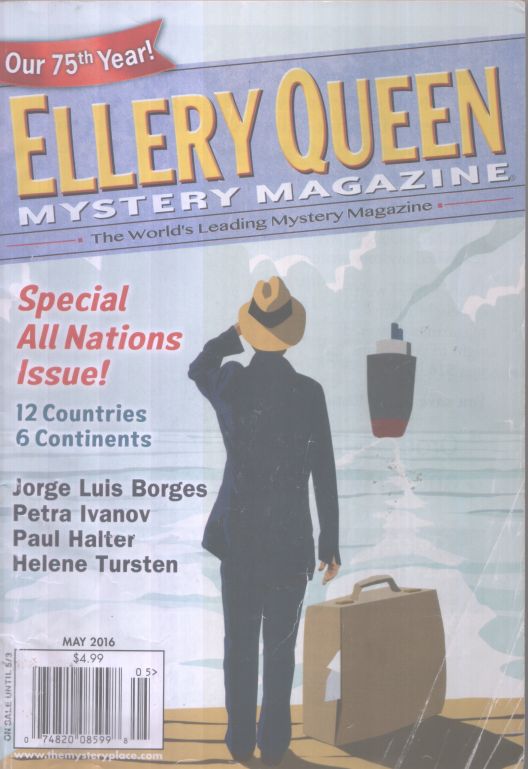
FROM OUR ARCHIVES
Cover photo by philip_g / Gettyimages.com |
Borges, Jorge Luis. “The Garden of Forking Paths,” translated by Anthony Boucher, reprinted in Ellery Queen Mystery Magazine, vol. 147, no. 5 (896), May 2016 (Special All Nations Issue), pp. 2-8.
“Short-story writer, poet, and critic Jorge Luis Borges is widely considered to have been one of the most important authors of the 20th century—perhaps its most important author. In his work some see the beginnings of “magical realism.” This story for EQMM 8/48 was his first fiction to appear in English. It was translated by eminent critic and author Anthony Boucher and entered in EQMM’s third annual contest. Borges influenced many later writers, especially in his native Argentina, as you’ll see in the story following his in this “All Nations” issue. For more on this special issue see page 21.”
Ferdinandus, Christian X. “For Strictly Literary Reasons,” translated from the Spanish by John B. Dalbor and Donald A. Yates, Ellery Queen Mystery Magazine, vol. 147, no. 5 (896), May 2016 (Special All Nations Issue), pp. 9-21.
“In the introduction to this issue’s lead story, we noted the profound influence Jorge Luis Borges had on subsequent writers. Cristian Mitelman and Fernando Sorrentino, who collaborate as “Christian X. Ferdinandus” (first EQMM appearance 6/08) are two such authors. Both are professors of literature in Buenos Aires. Cristian Mitelman is a widely published story writer and poet; Fernando Sorrentino’s works are translated into a dozen languages. The latter is the author of Seven Conversations with Jorge Luis Borges.”
In the introduction to his August 1948 “All Nations Issue,” EQMM editor Frederic Dannay wrote: “The outstanding development of last year’s Prize Contest was the unexpectedly large number of stories sent in from foreign countries and their remarkable range of geographical representation. Manuscripts were submitted from Canada, Mexico, Dominican Republic, Brazil, Argentina, China, Japan, the Philippines, Australia, Union of South Africa, Algeria, Southern Rhodesia, England, Ireland, France, Germany, Italy, Netherlands, and Portugal. This united effort on the part of detective-story writers proved that while we still have a long way to go politically, the planet Earth is truly One World detective-storywise.”
Many see the “internationalization” of crime fiction as a recent development, and certainly there are far greater opportunities for mystery writers to achieve translation and publication in markets other than their home countries now than there were then. But even in the forties EQMM played a role in bringing developments in the genre in other countries to its readers. The most notable example of this is the magazine’s publication of Jorge Luis Borges, the great Argentine author whose work leads this issue.
Dannay’s All Nations introduction went on to say: “To celebrate this United Nations effort on the part of detective-story writers, we have devoted this entire issue to the international scope of the detective short story, past and present.” Fourteen countries and “all six continents” were represented in the issue.
As part of the 2016 celebration of our 75th anniversary, we have created this second international issue, this time with stories from twelve countries and all continents except Antarctica. There are some important differences between this issue and the original to which we pay homage, however. The first is that, with the exception of the Borges story, there are no reprints between these covers. The second is that all but four of the stories are translations. When, in 2003, EQMM launched its (Continued page 71)
FROM THE EDITOR’S DESK: From the Four Corners of the World (continued from page 21)
Passport to Crime department it was with the goal of discovering authors never before translated into English. To accomplish this, it was necessary to identify, for a number of different languages, translators who could also serve as scouts for new material. In Dannay’s day, this proactive approach would have been difficult, for there were then far fewer novel-length foreign mysteries being published in English—and therefore fewer translators working in the genre.
In Dannay’s All Nations issue, contributor H.T. Alfon is quoted as saying in the cover letter to his submission, “Your magazine finds many readers even as far as here, Manila—EQMM has grown known that fast, that far.” EQMM did acquire a worldwide circulation very early on, and it was, by the century's midpoint, a widely translated magazine. Today, however, we can boast a different kind of global reach: We have more writers from abroad today than ever before, and if there’s one thing their work in this issue makes clear, it’s that we truly have become one world—a global village—and not only detective-storywise. —Janet Hutchings
*John B. Dalbor and Donald A. Yates’ collaboration goes back to their graduate-school days. In the sixties they brought out a college-level, Spanish-language textbook titled Imaginación y fantasia together. Dalbor is now Professor Emeritus at Penn State University and Yates Professor Emeritus at Michigan State University.
*Marlaine Delargy is a former secondary-school teacher who has translated many important writers, including Johan Theorin and Åsa Larsson, from Swedish to English.
*Clifford E. Landers is Professor Emeritus at New Jersey City University. Rubem Fonseca and Jorge Amado are among the many Brazilian authors he has translated.
*Josh Pachter is a writer, professor, and translator with more than four dozen short stories and many translations to his credit. His latest story collection is The Tree of Life.
*John Pugmire began translating while working in the computer industry. His first novel-length translation from French was released by Amazon. He created Locked Room International in 2011, publishing translations of French, Japanese, and Swedish puzzle mysteries. In 2012 he appeared on BBC Radio 4’s program Miles Jupp in a Locked Room.
*Mary Tannert is a former university teacher who's contributed more than two dozen translations to EQMM. She’s coeditor of Early German and Austrian Detective Fiction.
*Ho-Ling Wong translates Japanese detective fiction and regularly writes/blogs about it.
[p. 59]
Jorge Luis Borges: Selected Study Materials on the Web
Home Page | Site
Map | What's New | Coming Attractions | Book
News
Bibliography | Mini-Bibliographies | Study
Guides | Special Sections
My Writings | Other Authors' Texts | Philosophical
Quotations
Blogs | Images
& Sounds | External Links
CONTACT Ralph Dumain
Uploaded 11 August 2025
Site ©1999-2025 Ralph Dumain